Surah 33
(The Confederates)
(Madīnan Period)
Title
The title is taken from verse 20 of the surah which speaks of the invading confederates.
Period of Revelation
The surah discusses three important events: (1) the Battle of Aḥzāb also known as the Battle of Khandaq (that is, the Trench) which took place in Shawwal 5 AH/627 CE; (2) the Battle of Banu Qurayzah, which took place in Dhu al-Qa'dah 5 AH/627 CE; and (3) the Prophet's marriage to Zaynab, which was also solemnised in Dhu al-Qa'dah 5 AH/627 CE. In view of the above, the surah's period of revelation can be established quite accurately.
Historical Background
At the Battle of Uhud, in Shawwal 3 AH/625 CE, the Prophet (peace be on him) had posted archers at a certain vantage point.
Due to a lapse on their part the Muslim army suffered a setback. This boosted the morale of the polytheists of Arabia, as well as the Jews and hypocrites. They began to entertain the hope that they would soon be able to obliterate Islam and the Muslims.
Their growing confidence can be gauged from some of the events that took place soon after the Battle of Uhud. Hardly two months had passed after the battle than the Banu Asad, a tribe of Najd, began to make preparations to invade Madīnah. It was in order to restrain them that the Prophet (peace be on him) launched an expedition known as Sariyah Abu Salamah.*1 In Şafar 4 AH/625 CE, the 'Aḍal and Qarah tribes requested the Prophet (peace be on him) to dispatch some preachers to their region so as to invite people to Islam. Accordingly, he deputed six Companions. However, on reaching Raji', a location between Jeddah and Rabigh, unbelievers of the Hudhayl tribe attacked these helpless Companions at the instigation of the above-mentioned tribes. Of these, four were killed and two - Khubayb ibn 'Adi and Zayd ibn al-Dathinnah - were sold in Makkah. At the same time in response to the request of Banu 'Amir's chief, the Prophet (peace be on him) also sent to Najd a preaching mission consisting of 40 (though according to some reports, they were 70 in number) Anṣār youth. They too became targets of treachery. At Bi'r Ma'unah, members of the Banu Sulaym tribe, namely those belonging to 'Uṣayyah, Ri'l and Dhakwän, carried out a sudden attack, killing them all.
*1. Sariyah is the technical term for a military campaign in which the Prophet (peace be on him) did not personally take part. (Distinguished from that, ghazwah denotes a battle or military campaign which was led personally by the Prophet (peace be on him).
During the same period, Banu Nadir, the Jewish tribe settled in Madīnah, being emboldened by the events related above, persistently violated its pact with the Muslims. In Rabi' al-Awwal 4 AH/625 CE, they even conspired to assassinate the Prophet (peace be on him). In Jamad al-Awwal 4 AH/625 CE, two clans of Banu Ghaṭafān, namely Banu Tha'labah and Banu Muḥārib, planned to attack Madinah. Thus, the reverse suffered by the Muslims in the Battle of Uhud and the ensuing loss of their prestige continued to have an impact for some seven or eight months.
Thanks, however, to the Prophet's statesmanship and firm resolve and to his Companions' solid allegiance to the cause of Islam, the situation soon changed. For sure, the economic boycott imposed by the Arab tribes made life difficult for the Muslims of Madinah. Moreover, the unbelieving tribes around the city became increasingly aggressive. Within Madinah itself the Muslims were constantly exposed to the hostile machinations and conspiracies of the Jews and the hypocrites. However, a handful of true believers, under the Prophet's leadership, successively took a number of steps that restored, and even enhanced, the Muslims' awe and prestige.
Military Campaigns before Aḥzāb
The Muslims took the first decisive step just a day after the Battle of Uḥud. This was the moment when many Muslims lay nursing the wounds they had suffered during the battle and others mourned the loss of their near and dear ones. The Prophet (peace be on him) had himself suffered injuries on the battlefield and his heart lay shattered at the martyrdom of his own uncle, Hamzah. At that very juncture, however, the Prophet (peace be on him) directed Islam's devotees to set out in pursuit of the Makkan unbelievers' army that had just invaded Madīnah. This was done lest the enemy decide to turn back and launch another attack. The Prophet (peace be on him) thought that the enemy were returning home without taking full advantage of their victory. In the Prophet's estimation, once the unbelievers had camped for a while during their homeward journey they were bound to feel remorseful at their folly and this realisation would then lead them to mount another offensive. In an effort to thwart this, he decided to pursue the unbelievers' army. His call to arms was instantly greeted by 630 committed Muslims all of whom readily agreed to accompany the Prophet (peace be on him) in chasing the enemy.
While on his way to Makkah, the Prophet (peace be on him) camped for three days at Hamra' al-Asad. There he came to know from a sympathetic non-Muslim that Abu Sufyan, along with his 3,000 strong army, was camped at al-Rawḥā' some 36 miles from Madinah and that they intended to attack Madīnah again, believing that they had committed a mistake by not reaping the benefit from their victory at Uḥud. On coming to know of the Prophet's hot pursuit, however, they had abandoned their plan. This demoralised the Quraysh as well as the non-Muslim tribes around Madinah that were hostile to Islam and the Muslims. Not only that, but they also began to recognise that the Muslims were led by an ever-vigilant and resolute leader, one who enjoyed the utmost devotion and loyalty of his followers. (For further details see Towards Understanding the Qur'an, Vol. I, Introduction to Surah Āl 'Imrān, pp. 229-232.)
Subsequently, no sooner had the tribesmen of Banu Asad begun their preparations to invade Madīnah than the Prophet (peace be on him) came to know of their plan through his informers. Before they could carry out the strike, the Prophet (peace be on him) had dispatched a contingent of 150 Companions led by Abū Salamah (the husband of Umm Salamah before she was married to the Prophet) to ward off their incursion. The Muslim contingent surrounded their enemy suddenly and swiftly. In a fit of panic, the latter beat a hasty retreat leaving behind their provisions, which fell to the Muslims.
Next, it was the turn of Banu al-Naḍīr. The day their conspiracy to assassinate the Prophet (peace be on him) came to light, they were served with a notice to leave Madīnah within ten days. They were warned that those who failed to do so would be put to the sword. 'Abd Allah ibn Ubayy, the chief of Madīnah's hypocrites, encouraged Banu al-Naḍīr to hold on and not leave Madīnah. Not only did he promise to aid them with his 2,000 strong force, but also told them that the Banu Qurayzah and Banu Ghaṭafān of Najd might also come to their aid. Encouraged by these false promises, Banü al-Nadir sent word to the Prophet (peace be on him) that they would not vacate Madinah, challenging the Muslims to do whatever they wished. Consequently, no sooner had the period of notice passed than the Prophet (peace be on him) laid siege around their quarters. Ironically, none of their supporters had had the courage to come forward. Eventually, Banu al-Naḍīr laid down their arms on the condition that each group of three people from their tribe would be allowed to carry their belongings with them on one camel, leaving the rest behind in Madīnah. Thus their quarters, in the suburbs of Madīnah, consisting of orchards, fortresses and a considerable quantity of valuables, fell to the Muslims. Thereafter, these treacherous people became scattered far and wide between Khaybar, Wādī al-Qurā and Syria.
The Prophet (peace be on him) then turned his attention to Banu Ghaṭafān who had also drawn up plans to attack Madinah. He marched out at the head of a 400 strong contingent and seized them unawares at Dhat al-Riqā'. Stricken by panic, they dispersed into the nearby hills, abandoning their hearths and homes.
In Sha'ban 4 AH/626 CE, the Prophet (peace be on him) went out in response to a challenge thrown down by Abu Sufyān on his way back from the Battle of Uhud. In this respect, he had warned the Muslims in general, and the Prophet (peace be on him) in particular, that in the following year there would be another encounter between them and the Muslims at Badr. The Prophet (peace be on him) had then asked one of his Companions to convey the following reply to Abu Sufyan: "Yes, that is the tryst between us and you". In accordance with this, the Prophet (peace be on him) set out along with 1,500 Companions and reached Badr on the appointed day. Abu Sufyan, too, set out with a 2,000 strong army for Badr. However, he could not muster sufficient courage to go beyond Marr al-Zahran, currently known as Wādī Fatimah. The Prophet (peace be on him) camped at Badr and waited for Abū Sufyan for eight days. During this period, the men constituting the Muslim army engaged in trade and made good money. This incident also helped to reinforce the prestige of the Muslims after their discomfiture at Uḥud. As a result, it became clear to people all across Arabia that the Quraysh were no longer powerful enough to singly take on the Prophet (peace be on him) and his Companions. (For further details see Towards Understanding the Qur'an, Vol. I, Surah Al 'Imrān, n. 124, pp. 300-301.)
The Muslims gained further prestige as a result of the following incident. Arab trade caravans en route to Iraq, Egypt and Syria used to pass through Dūmat al-Jandal (presently known as al-Jawf).
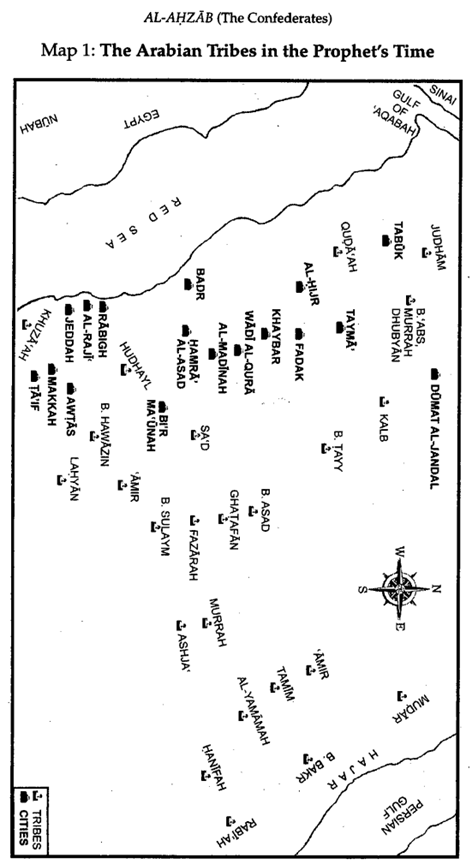
Its inhabitants used to harass and often rob those caravans. In Rabi' al-Awwal 5 AH/626 CE, the Prophet (peace be on him) led an expedition with a 1,000 strong army to discipline them. The inhabitants of Dümat al-Jandal were terror-struck and fled from their homes. This established the supremacy of the Muslims in the whole of north Arabia. Furthermore, the tribesmen living in the vicinity of Madīnah realised that it was beyond the ability of just a tribe or two to confront Islam's rising power. (see Map 1)
The Battle of Aḥzāb
The historical background outlined above also provides the circumstantial setting for the Battle of Ahzab. To put it succinctly, the battle represented a joint military venture of a conglomerate of Arab tribes aimed at smashing the base of Muslim power in Madinah. The venture was initiated by the exiled Banu al-Naḍīr chiefs who had taken refuge in Khaybar. They had toured the entire region persuading the Quraysh, Ghaṭafan, Hudhayl and several other tribes to rally under a single banner and pounce on Madinah.
Their sustained efforts bore fruit in Shawwal 5 AH/626 CE. A huge army consisting of many tribes descended on Madīnah. This conglomerate of tribes was itself unprecedented. From the north, the exiled Jews of Madīnah belonging to Banu al-Naḍīr and Banū Qaynuqā', who had settled in Khaybar and the Wādī al-Qurā, made their way to Madīnah. From the east, the following tribes moved forward: Banu Sulaym, Fazārah, Murrah, Ashja', Sa'd and Asad. From the south, the Quraysh, accompanied by a host of allies, made their advance. In all, a large army numbering between 10,000 and 12,000 set out towards Madinah.
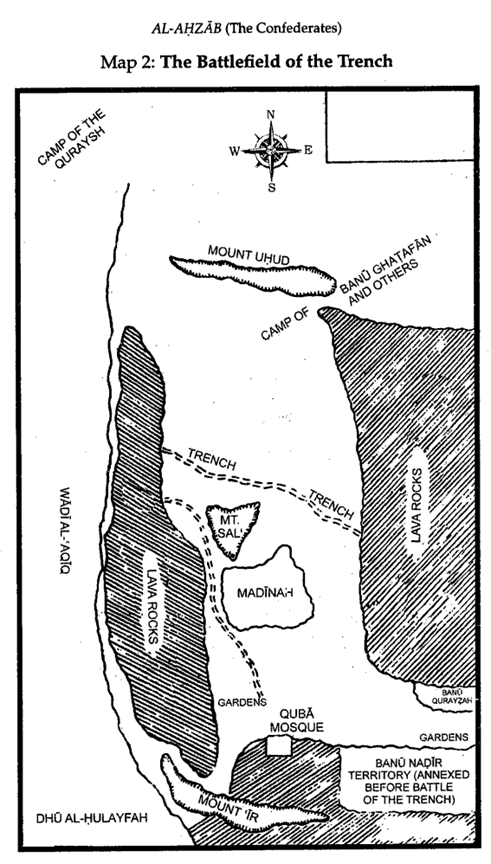
Had this attack taken the Muslims unawares it would have resulted in a devastating blow to them. However, although the Prophet (peace be on him) lived in Madīnah, he was not unaware of the ominous developments taking place around him. His informers and those who were either favourably impressed by or sympathetic to the Islamic movement - and there were plenty of them in the ranks of various tribes - kept him constantly abreast of his enemies' moves.*2 Hence before this huge army could reach Madīnah, the Prophet (peace be on him) was able to dig a trench on the north-west side of Madīnah in just six days' time. Having done so, the Prophet (peace be on him) then positioned his 3,000 strong army with Mount Sala' to the rear. To the south of Madinah, there were quite a few dense, impenetrable orchards making it difficult for anyone to launch an offensive from that side. To the east, there stood huge rocks, the result of lava outflows, that ruled out any major attack from that side. The same was true of the western- southern side. Hence, the enemy could only move forward from the eastern and western flanks of Mount Uhud. It was there that the trench had been dug to protect the city, a strategy the unbelievers had no inkling of. Indeed, it had never occurred to them that they would encounter a trench outside Madīnah; the enemy had simply not taken this possibility into account. In fact, they were altogether unfamiliar with such a defence strategy. Unable to do anything else, they were forced to settle in for a prolonged siege in extremely cold weather conditions, something they had not anticipated. (see Map 2)
*2. This is an important advantage that an ideological movement has over and against nationalist bands. For nationalists can only count on the support of those belonging to their nation. Conversely, a movement that invites people to a set of principles and an ideology, has the potential to expand in all directions. It is thereby able to extract supporters even from the ranks of its enemies.
One option, however, was left for the invading unbelievers: to incite the Jewish tribe of Banu Qurayzah, who were then settled in the south-eastern part of Madīnah, to commit perfidy against the Muslims. Thus far Banu Qurayzah had been the Muslims' allies and were even bound by an agreement to defend Madīnah in the event of an attack upon it. The Muslims, therefore, trusted them and had even moved their family members into their fortresses. Because of this trust, they had also taken no precautionary measures for the defence of that area. Noting this vulnerability, the unbelievers deputed Huyayy ibn Akhtab, the chief of Banu al-Naḍir, to Banũ Qurayzah with the mission to persuade them to break their alliance with the Muslims and join the battle against them. Initially, Banu Qurayzah rejected the suggestion, plainly
telling Huyayy ibn al-Akhtab that they were bound to the Muslims by an alliance and that they did not nurse any grievance against them. Ibn al-Akhtab, however, persisted in his plea, arguing with them as follows: "Look! Here is an opportunity. We have mustered the whole of Arabia against Islam. If you let this opportunity go by, you will never have another." Ultimately, the Jews' propensity for hostility towards Islam got the better of them. They, thus, decided to disregard the requirements of morality and breached their pact with the Muslims.
The Prophet (peace be on him) was not unaware of these developments for he had been receiving timely intelligence about them. He directed the Anṣār chiefs - Sa'd ibn 'Ubadah, Sa'd ibn Mu'adh, 'Abd Allah ibn Rawāḥah and Khawwāt ibn Jubayr - to meet with the Jewish tribal leaders and dissuade them from violating their pact. As they were about to leave, he instructed them that if Banü Qurayzah pledged to abide by their pact with the Muslims, then they, the Anṣār chiefs, should come forward and announce the same publicly. If the Jews' decision was otherwise, however, then the Anṣär chiefs were to divulge the news to the Prophet (peace be on him) alone so that the Muslims' morale was not undermined. When the Muslim delegation reached the Jewish quarters, they discovered that the Banữ Qurayzah were bent on mischief. They plainly told the delegation that there was no longer any pact between them and the Prophet (peace be on him). The Muslim delegation returned to the Prophet (peace be on him) and relayed the actual situation by simply uttering: ""'Aḍal and Qarah." This meant that Banu Qurayzah were going to commit the same treachery that had earlier been committed by the 'Aḍal and Qārah tribes who had treacherously killed the Muslim preachers at Raji'.
The designs of Banu Qurayzah soon became known throughout Madīnah. Inevitably, this upset the Muslims. For not only were they surrounded by the enemy on both sides, but were now also vulnerable to attack from a part of Madīnah against which they had not erected any defence. Furthermore, their family members had been moved to that same area for safety. It was now clear that the trust the Muslims had given Banu Qurayzah was misplaced. This situation was further exploited by the hypocrites who launched a psychological offensive to further demoralise the Muslims. For instance, they would say something to the following effect: "Look! We were given to understand that the Roman and Persian Empires would soon be conquered. However, the ground reality is such that we cannot even go out of our own homes to answer a call of nature." Some even launched a whispering campaign suggesting that the Muslims should strike a deal with the besieging enemy, a deal stipulating that the Prophet (peace be on him) would personally be handed over to them. It was indeed a time of great trial in the course of which those who had even an iota of hypocrisy in them were exposed. In this hour of crisis the true believers displayed undaunting resolve and commitment, remaining utterly faithful and steadfast.
At this critical juncture, the Prophet (peace be on him) initiated negotiations with Banu Ghaṭafan, offering them one-third of Madīnah's harvest if they were to dissociate themselves from the siege. The Prophet (peace be on him) consulted the Anṣār chiefs, Sa'd ibn 'Ubadah and Sa'd ibn Mu'adh, regarding the terms of this truce. These notable Anṣär leaders asked the Prophet (peace be on him) whether they were obliged to accept all this as a directive from God or whether it was a strategy designed to protect Madīnah. The Prophet (peace be on him) affirmed that it was the latter, a policy he himself had designed to protect Madīnah against all the machinations of the Arabian tribes. The Anṣār chiefs then replied to him as follows: "If you want to conclude this truce for our sake, then do away with it. These tribes were not able to extract any levy from us even when we were polytheists. Now we are much stronger by dint of our faith in God and His Messenger (peace be on him). So, how can they now exact any tax from us? Only the sword will settle the issue. God is the Best to decide the matter." So saying, they tore into pieces the draft of the truce which had yet to be signed by the two parties.
In the meantime, Nu'aym ibn Mas'ud, a member of the Ashja' clan of Banu Ghaṭafan, who had embraced Islam, called on the Prophet (peace be on him). He told him that his acceptance of Islam was not yet known to anyone and, hence, he could be useful in gathering intelligence. Subsequently, the Prophet (peace be on him) directed him to create discord among the enemy ranks.*3 As a result, Nu'aym first approached Banu Qurayzah with whom he had very good relations. He gave them the impression that they (to wit, Banu Qurayzah) were in a very vulnerable position for it was possible that the Quraysh and Banu Ghaṭafān might withdraw in exasperation, thereby lifting the siege. Banu Qurayzah, being the Muslims' neighbours, would then have to fend for themselves. He suggested to them that they should take an active part in the battle only if the Quraysh and others sent them some leading members from the various tribes as hostages. This appealed to Banu Qurayzah and, indeed, they did ask that some people be handed over to them as hostages.
*3. On this occasion the Prophet (peace be on him) said: "Resort to artifice. to mislead [the enemy] is permissible in warfare."
Nu'aym then visited the chiefs of Quraysh and Ghaṭafān, telling them that Banu Qurayzah did not appear very warm in their commitment to fight alongside them and that it was very likely that they would demand some of their leading members to be handed over as hostages. If this happened, Banu Qurayzah would then hand over these hostages to the Prophet (peace be on him) in exchange for a deal that they might then strike with him. So doing, he pressed home the point that they should be cautious in their dealings with Banu Qurayzah.
In this manner, the allies became mutually suspicious. The Quraysh and Ghaṭafān chiefs sent word to Banu Qurayzah that they were tired of the long, drawn-out siege, that they soon intended to launch a decisive attack and that Banu Qurayzah should, therefore, also launch their own strike because a two-pronged attack would unsettle the Muslims. To this, Banữ Qurayzah responded by saying that the Quraysh and Ghaṭafan should send them some of their men as hostages, for unless they did so, they would not risk launching an attack on the Muslims. This response went straight to the hearts of the Quraysh and Ghaṭafan. In essence, it confirmed what Nu'aym had told them with regard to Banu Qurayzah's reservations. They, thus, refused to offer anyone as hostage. This refusal, in turn, convinced Banu Qurayzah of the
validity of Nu'aym's apprehension, which he had expressed to them. In sum, Nu'aym's stratagem proved to be a master stroke, one that caused division in the unbelievers' ranks.
The siege had lasted for more than 25 days during a harsh winter. It was also becoming harder by the day to arrange provisions for a huge army that was also demoralised because of internal divisions. Then, came the last straw that broke the confederates' back. One night, a violent hail storm swept through the area, uprooting the tents of the besieging force. In the total darkness of night, they could do nothing to defend themselves against nature's onslaught. Overtaken by panic, they retreated during the night to wherever they had come from. When the Muslims woke the next morning, there was not a single enemy soldier in the vicinity of Madīnah. On noting their desertion the Prophet (peace be on him) exclaimed: "From now on, the Quraysh cannot invade you. Rather, you will attack them." (Bukhārī, Kitāb al-Maghāzi, Bāb Ghazwat al-Khandaq - Ed.)
This was indeed an accurate assessment of the situation. The Quraysh, combined with the other tribes opposed to Islam, had made their last concerted effort against the Muslims. They lost this opportunity and no further opportunities to launch another attack would present themselves. The initiative for offensive, therefore, now lay with the Muslims.
Campaign of Banu Qurayzah
When the Prophet (peace be on him) returned home from the Battle of Aḥzāb (also called the Battle of the Trench), Gabriel came to him at the time of Zuhr Prayer and asked him not to lay aside his arms. He was told instead that the problem of Banu Qurayzah should be settled forthwith. On receiving this directive, the Prophet (peace be on him) proclaimed: 'Whoever owes allegiance to me should offer 'Aşr Prayer until they reach the quarters inhabited by Banu Qurayzah.' (Bukhārī, Kitāb al-Maghāzī, Bāb Marji' al-Nabī min al-Aḥzāb - Ed.) At the same time, he dispatched a vanguard party under 'Ali's command towards Banu Qurayzah's quarters.
On his arrival, 'Ali was greeted with a barrage of abuse and obscenity directed at the Prophet (peace be on him) personally and the Muslims generally. This despite the fact that it was Banū Qurayzah who were guilty of perfidy with the Muslims during the critical days of the siege. They had colluded with the invaders, exposing Madinah's entire population to the possibility of death and destruction. They could not, therefore, be allowed to escape punishment. Initially, on noting only a small party led by 'Ali, Banü Qurayzah thought these Muslims had advanced merely to threaten them. Behind 'Ali, however, came the whole Muslim army under the Prophet's own command and in this way the Qurayzah were surrounded. Totally unnerved and conscious of the fact that they could not sustain a siege for more than two or three weeks, they surrendered on the condition that their case would be adjudged by Sa'd ibn Mu'adh, the Aws chief. They had selected Sa'd as their arbiter because the Banu Qurayzah and Aws had been allies for a long time, essentially since the days of Jahiliyah. They, thus, believed that Sa'd ibn Mu'adh would be influenced by this longstanding relationship. In other words, they expected that like Banu Qaynuqā' and Banu al-Naḍīr, they too would be offered safe passage. Indeed, members of the Aws tribe did urge Sa'd to act leniently towards Banu Qurayzah.
Sa'd, however, had noted that those Jewish tribes that had been granted safe passage in the past had abused it and had further been instrumental in inciting tribes from all around to attack Madīnah. This, as we know, led to the invasion of Madinah by an army 10,000 to 12,000 strong. Sa'd was also aware that Banu Qurayzah had committed a ghastly act of treachery during the Aḥzāb Campaign. So doing, they had exposed all the people of Madinah to a potentially devastating onslaught. He, therefore, decided that all male members of the Qurayzah be put to death, their women and children be taken as slaves, and their possessions be distributed among the Muslims. This sentence was duly executed.
Later, when the Muslims entered the Jewish fortresses, they discovered that these traitors had amassed 1,500 swords, 300 body armours, 2,000 daggers and 1,500 shields. Had God not come to the Muslims' aid, these weapons would indeed have been used against them from within Madinah and the unbelievers and polytheists would have crossed the trench to swoop upon them from that quarter. The haul of these arms removes any doubt about Sa'd's sagacity in ordering the execution of the male members of the Banu Qurayzah.
Social Reforms
In the intervening two-year period between the Battle of Uhud and the Ahzab Campaign, the Prophet (peace be on him) and his Companions did not enjoy a moment's peace or tranquillity because of the recurrent troubles and dangers they faced. Nevertheless, the effort to construct a new Muslim society and to bring about reforms in all aspects of life continued apace even during this hectic period. It was also around this time that the promulgation of Islamic laws on marriage, divorce and inheritance were more or less completed. Furthermore, drinking and gambling were forbidden and several new norms were also introduced into the Muslims' social and economic life.
Another related issue that called for reform was the institution of adoption. Up until then the Arabs used to consider their adopted children like their real children, who were, therefore, entitled to a share in inheritance. In turn, the adopted son's mother and his sister by adoption would also share the same close relationship they enjoyed with their real son and brother. As a result, it was not permissible for any adopted son to marry his sisters by adoption, or to marry the divorced or widowed wife of his father by adoption. Such a marriage was considered as outrageous as a person marrying his real sister or mother.
These practices were in flagrant conflict with the Qur'ānic laws of marriage, divorce and inheritance as laid down in Surahs al-Baqarah (Surah 2) and al-Nisa' (Surah 4). This Arab practice also deprived legitimate heirs of a part of their due share in inheritance and transferred it to those who were not entitled to any share at all. These practices also disallowed marriage between those men and women who were allowed by the Qur'an to marry. More importantly, these practices contributed to moral corruption which Islamic law sought to forestall. This because the artificial sanctity of ties based on adoption did not and could not have the sanctity characteristic of blood ties. When men and women who are joined in kinship by adoption freely mix with each other, moral lapses are likely to occur.
Hence the dictates of Islamic law on marriage, divorce, inheritance and the sanctity of sexual relations required that treating adopted kin as equivalent with blood kin be abolished once and for all.
The practice of adoption, however, was too deeply entrenched to be scrapped simply by proclaiming that kinship by adoption was not the same as blood kinship. Ideas with deep roots in the past cannot be done away with simply by verbal declarations. Even if people recognised in principle that ties based on adoption do not have the same effect as blood ties, they would nevertheless have continued to be outraged by the idea that a mother by adoption and her adopted son could intermarry. The same applied to marriage between a brother by adoption and his sister by adoption, between a father by adoption and his adopted daughter, and between a father-in-law by adoption and his daughter-in-law by adoption. Moreover, there continued to be a degree of free mixing among people of the above-mentioned categories. It was necessary, therefore, that things be set right and only the Prophet (peace be on him) could take an effective initiative in this regard. For his action, carried out under God's directive, would leave no room for any doubt or reservation in any Muslim's mind. It was for these reasons that a little before the Ahzab Campaign God had suggested to the Prophet (peace be on him) that he marry Zaynab, the divorced wife of his adopted son, Zayd ibn Harithah. He complied with this during the siege of Banu Qurayzah. (This delay in compliance was presumably because Zaynab's waiting period was not then over and the Prophet (peace be on him) himself was preoccupied with matters relating to the impending battle.)
Malicious Propaganda over the Prophet's Marriage with Zaynab
No sooner had the Prophet (peace be on him) married Zaynab than a malicious propaganda campaign of massive proportions was let loose against him. The polytheists, hypocrites and Jews each had an axe to grind. They were jealous of the Prophet's successes on every front. For two years, from the Battle of Uhud through the Aḥzāb Campaign and the Battle of Qurayzah, the enemies had successively suffered humiliating defeats. They had, therefore, lost hope that they would ever be able to put up an effective fight against the Prophet (peace be on him) in open warfare, let alone defeat him.
All these disgruntled elements, therefore, tried to destroy the Prophet's high moral ground which lay at the core of his phenomenal success. In this respect, they invented and circulated a malicious story to the effect that the Prophet (peace be on him) had fallen in love with Zaynab, his daughter-in-law by adoption, and that when his adopted son, Zayd, came to know of this, he divorced her. The Prophet (peace be on him) was thus accused of marrying his own daughter-in-law. This was a baseless and sinister allegation. Zaynab was the Prophet's maternal cousin, and he had known her from her childhood. Hence the notion that the Prophet (peace be on him) was charmed by the sight of her, fell in love with her, was simply absurd. In fact, it was he who had suggested, even insisted, that Zayd and Zaynab be married. In so doing, he had even courted the displeasure of his own family members for they could not reconcile themselves with the idea that a girl of such a noble Quraysh family be married to a freed slave. Even Zaynab was not quite happy with this marriage proposal. However, she showed deference to the Prophet's wish on the question of marriage.
The marriage between Zayd and Zaynab sent a loud and clear message throughout Arabia that in Islam a freed slave enjoys the same status as a nobleman of the Quraysh. Had the Prophet (peace be on him) been interested in marrying Zaynab, he need not have arranged her marriage to Zayd in the first place. In other words, there was nothing to prevent him from marrying Zaynab if he had so wanted. Nevertheless, even in the face of these undeniable facts, unashamed enemies invented and then spread malicious stories about the Prophet's 'affair' with Zaynab. So fierce and effectively articulated was this propaganda that it found its way even among the ranks of Muslims.
Initial Injunctions about Hijāb
The fact that these sinister stories circulated by enemies penetrated the Muslim community did not reflect well on its moral health. In other words, the incident showed how lavisciousness in society exceeded the limits of moderation. Had this propensity not been there, people would not have countenanced such outrageous allegations against such a pious figure as that of the Prophet (peace be on him), let alone verbally repeat these stories. It was precisely at this juncture that a reform programme under the rubric of hijāb was introduced in Muslim society. Although these reforms were introduced in the surah under study, they were given legal shape in Surah al-Nur (Sürah 24), one year after slanderous statements were made about 'A'ishah. (For details see Introduction to Surah al-Nur, Towards Understanding the Qur'an, Vol. VI, pp. 133-147.)
The Prophet's Domestic Life
Two other issues at that time deserved urgent attention. Although these problems were related to the Prophet's domestic life, they were nonetheless significant for they had a bearing on the cause of Islam. The Prophet (peace be on him), as we know, was wholly occupied with striving to promote the true faith. It was imperative, therefore, that he should enjoy the kind of peace and equanimity in his domestic life that would enable him to fully concentrate on his mission. Moreover, it was also necessary that no aspect of his life should give rise to any doubts or misgivings in the minds of people. God, therefore, addresses both these issues in this surah.
The first issue concerns the financial stringency then facing the Prophet (peace be on him). In fact, during the first four years of his life in Madinah he did not have any mentionable source of income. It was only in 4 AH/625 CE, after the exile of Banu al-Naḍīr, that a part of the land left behind by them was allocated to him under God's command so as to enable him to meet his expenses. The income so generated, however, did not suffice for his family's subsistence. His mission as God's Messenger kept him exceedingly busy so that he could not spare his physical or mental energy on tasks other than those pertaining to his mission. Hence, when his wives complained of financial stringency the Prophet (peace be on him) inevitably became even more stressed.
Before his marriage with Zaynab, the Prophet (peace be on him) already had four wives - Sawdah, 'A'ishah, Hafsah and Umm Salamah. Zaynab was, therefore, his fifth wife. This provided his detractors with a pretext to raise objections against him and even some Muslims were carried away by their malicious propaganda. In particular, they were particularly rankled at the fact that the Prophet (peace be on him) had five wives whereas other Muslims had been restrained from marrying more than four.
Subject Matter and Themes
These are the problems that obtained at the time this surah was revealed and it naturally addresses these problems.
The surah consists of several pieces of discourse revealed at different periods of time in the context of the major events then pertaining but which were integrated into one surah. The major elements of which the surah is comprised are as follows:
i. The opening verses of the surah (vv. 1-8) appear to have been revealed a little before the Aḥzāb Campaign. Viewed in its historical setting, it seems that at the time of their revelation, Zayd had indeed divorced Zaynab. The Prophet (peace be on him) felt the need to do away with the concepts, superstitions and practices of pre-Islamic times relating to adoption. Therefore, he considered marrying Zaynab. On the other hand, he was reluctant to do so apprehending that this would trigger a fierce opposition from anti-Islamic forces - especially the hypocrites, Jews, and polytheists.
ii. The next two sections of the surah (see vv. 9-27) constitute the Qur'anic critique on the Campaigns of Ahzab and Qurayzah. Obviously, these sections were revealed after the events had taken place.
iii. The discourse from verse 28 through verse 35 makes two important points. First, God served notice on the Prophet's wives to make a choice between worldly life and its allure- ments on the one hand and the Prophet (peace be on him) on the other. They were asked to express their preference in clear terms. If they chose this worldly life and its allure- ments, they would not be held to blame; rather, they would gladly be allowed to exercise their choice. However, if they chose the other option, they would be required to patiently persist in supporting God and His Messenger (peace be on him) even in straitened circumstances. Secondly, some preliminary steps were taken towards the realisation of the contemplated social reform. In fact, those whose mental outlook had been shaped by Islam had already begun to feel the need for it. Nonetheless, initial reform commenced from the Prophet's own household. Accordingly, his wives were asked to speak in a straightforward manner and not be complaisant when speaking to unrelated men, to stay in their homes and not to go about displaying their allure- ments as in the Time of Ignorance. In this respect, the surah marks the beginning of the Qur'anic prescriptions about hijab for women.
iv. Verses 36-48 deal with the Prophet's marriage with Zaynab and respond to the objections made by Islam's detractors.
v. Verse 49 lays down an important provision of Islamic law, the provision pertaining to divorce. It is a distinct verse which was presumably revealed in the context of the events obtaining at the time.
vi. Verses 50-52 contain the special rules of marriage exclusively meant for the Prophet (peace be on him). It was, therefore, made clear that the Prophet (peace be on him) was not subject to the several interdictions laid down for common Muslims.
vii. Verses 53-55 represent another major step in the direction of social reform. Specifically, these lay down the following injunctions: restriction on the entry of unrelated men to the Prophet's house; a code of social interaction; outlawing the marriage of the Prophet's wives to all other men, and the injunction that Muslims treat the Prophet's wives as their mothers.
viii. Verses 56-57 (sic; read verses 55-58 - Ed.) reproach those who had raised much hue and cry at the Prophet's marriage and family life. The believers were asked to invoke God's blessing and peace upon the Prophet (peace be on him) and to stay clear of fault-finding in the manner of Islam's enemies. They were also directed to leave the Prophet (peace be on him) alone, and to avoid causing hurt even to ordinary believing men and women by making them a target of accusation and slander.
ix. Verse 59 introduces another measure of social reform. It directs all Muslim women to wrap themselves up when they go out and to draw a part of their outer coverings over their bodies.
From here on till the end of the surah, the whispering campaign mounted by the hypocrites and by people of superficial understanding and low character comes up for strong censure.