Surah 12
(Joseph)
(Makkan Period)
Period of Revelation
Upon examination of the contents of this surah, it would appear that it was probably revealed in the last phase of the Prophet's life in Makka. At that time the Quraysh were considering ways of how to get over the threat posed by the Prophet (peace be on him): whether to kill, or banish, or imprison him.
At the same time, probably at the instigation of the Jews, some of the Makkans tried to test whether the Prophet (peace be on him) derived his knowledge from on high or not. To this end they asked him: what caused the Israelites to migrate to Egypt? They asked this question because the Arabs were unfamiliar with the story; there was no trace of it in their historical traditions. More importantly, the Prophet (peace be on him) had not referred to it before.
The Makkans, therefore, thought that there were only two possibil- ities. One, that the Prophet (peace be on him) would answer the question but would fail to answer it in detail. The other possibility was that under one pretext or the other, he would try to defer answering the question so as to gain time. They also thought that the Prophet (peace be on him) would subsequently solicit help from some of the Jews and this would inevitably and completely expose him. It would then become clear to all that he had no access to the Divine source of knowledge.
But the result of the test was quite contrary to their expectations. For God enabled the Prophet (peace be on him) to narrate the whole story of Joseph then and there. Not only that but the story was wholly applicable to the contemporary situation of the Quraysh. It showed that the Quraysh were playing the role of Joseph's brothers.
Main Objectives of the Surah
The story was revealed to achieve two main objectives. Firstly, in order to provide proof that would establish Muḥammad's claim to be a Prophet. It was also significant that the evidence which was being provided was proof asked for by the opponents themselves rather than proof which was volunteered by the Prophet (peace be on him). Thus, it was possible to establish, by the test which the Prophet's opponents had themselves proposed, that his source of knowledge was revelation rather than hearsay. This purpose is spelled out firstly in verses 3 and 7, and quite forcefully again in verses 102-3.
The second purpose in revealing this surah was to highlight the close resemblance of Prophet Joseph's and his brothers' story, with the situation then pertaining in Makka. The resemblance was so close that the very narration of Joseph's story amounted to a reminder to the Quraysh that their attitude towards the Prophet (peace be on him) was similar to that of Joseph's brothers. Now, Joseph's brothers failed to defeat God's plan. Instead, they lay humbled at the feet of their brother, a brother whom once they had callously cast into a pit. The implication being that the Quraysh will meet a similar end; their machinations against God's plan will be reduced to naught. A time will come when the Quraysh, in the manner of Joseph's brothers, will also be forced to beg for the mercy of the same brother whom they were once bent on annihilating. This purpose has also been set forth in the very opening part of this surah (see verse 7) where it has been said: 'Verily in the story of Joseph and his brothers there are many signs for those who inquire (about the truth).'
By linking the story of Prophet Joseph (peace be on him) to the encounter between Prophet Muḥammad (peace be on him) and the Quraysh, the Qur'an virtually prophesied what was going to happen. The events which unfolded during the ten years following the revelation of this surah, represent the fulfilment of that prophesy.
One year and a half or two years after the revelation of this surah the Quraysh hatched a conspiracy against the Prophet (peace be on him). They did so in a manner reminiscent of the conspiracy of Joseph's brothers. Like Joseph's brothers, the Quraysh attempted to assassinate the Prophet (peace be on him). To ensure the security of his life he was forced to migrate from Makka. Then again, during his exile, the Prophet (peace be on him) was able to gain ascendancy and power in a manner that reminds one of Joseph (peace be on him). What happened to the Makkans on the occasion of the conquest of Makka was exactly the same as had befallen Joseph's brothers on their last appearance before him in the capital of Egypt. Joseph's brothers begged him to show them mercy. In a pitiable predicament they stood before Joseph (peace be on him), imploring: 'So give us corn in full measure and give it to us in charity. Allah rewards those who are charitable' (Yusuf 12: 88). Although Joseph (peace be on him) had the power to avenge himself, he pardoned them, saying: 'No blame lies with you today. May Allah forgive you. He is the Most Merciful of all those who are merciful' (Yusuf 12: 92).
After the conquest of Makka, the vanquished Quraysh also stood humbled before Prophet Muhammad (peace be on him). The Prophet (peace be on him) also had full power to avenge himself. Instead, he inquired of them: 'How am I going to treat you?' They replied: 'You are a magnanimous brother and the son of a magnanimous brother.' To this the Prophet replied: 'I say to you what Joseph said to his brothers: "No blame lies with you today. May Allah forgive you. He is the most Merciful of all those who are merciful." You may go, all of you are free.' (Al-Waqidī, al-Maghāzī, vol. 2, p. 835 - Ed.)
Main Themes
The two subjects mentioned above constitute the main themes of the surah. However, like other stories in the Qur'an, the present story has not been narrated either for the sake of story-telling, nor just for the recording of historical facts. Instead, the story has been used as a means to effectively communicate the basic message of the Qur'an.
This story also brings into sharp relief the fact that the religion of Prophets Abraham, Isaac, Jacob and Joseph (peace be on them) was the same as preached by Prophet Muhammad (peace be on him). Those Prophets had earlier invited people to exactly the same basic teachings to which Prophet Muhammad (peace be on him) invited people in his time.
Through this story the Qur'an highlights the conduct of Prophets Jacob and Joseph (peace be on them), showing how it contrasts with the character and conduct of Joseph's brothers, of the members of the trading caravan, of the wife of the chief official ('aziz), of the upper- class ladies and ruling coterie of Egypt. These contrasting images automatically raise certain questions in the minds of those who notice the difference. For they see, on the one hand, the ideal characters which develop out of belief that one should surrender to the Will of God and have a strong faith in one's accountability in the Hereafter. On the other hand, they see the characters of an altogether different kind, characters moulded by unbelief and ignorance, by excessive worldliness and lack of any concern for God and the Hereafter. Once acquainted with these contrasting traits, everyone is able to ask his conscience: 'Which of these two models is to my liking.'
Through Joseph (peace be on him), the Qur'an also drives home another profound truth. It underscores that whatever God wills to happen, does indeed come to happen. By his own scheming man can neither succeed in defeating God's plan, nor alter it. In fact, very often man works to execute some of his plans and everything seems to proceed satisfactorily, leading him to believe that he has succeeded in striking his target. But if the plan is not in accord with God's plan, he eventually discovers that all his efforts have been in vain, and that he has, in fact, implemented God's plan rather than his own.
What has been said above is well illustrated by Joseph's story. Joseph's brothers believed that he was the major impediment in the fulfilment of their ambitions. It is for this reason that they cast him into a pit. When that was done, they believed that they had removed that impediment from their way, once and for all. But what actually happened was that they were instrumental in placing Joseph on the first rung of the ladder which would take him to the great heights of eminence which God had destined for him. Furthermore, their behaviour earned them, in the end, utter humiliation and embarrass- ment. For instead of visiting Joseph (peace be on him) - their brother- in an honourable way, they were compelled by force of circumstance to humble themselves before him and seek pittance from him. Likewise, the wife of the Egyptian chief sought to take her revenge on Joseph (peace be on him) by means of his imprisonment. But as future events showed, her action paved the way for Joseph's rise to power and glory. As for her own self, she subsequently had to suffer the embarrassment of publicly confessing her perfidy. By her action she deprived herself of the honour and prestige that she might have enjoyed as the godmother of the ruler of Egypt.
These are not isolated incidents. History is replete with instances which bear out that no one can bring into disgrace anyone upon whom God wants to bestow honour. For God turns the tables against those who plan to humiliate someone whom He wills to honour. The result is that the efforts of such a person's opponents only contribute to his rise and success. As for those who devise hostile schemes, they receive only humiliation and disgrace. Likewise, when God decides to bring about someone's downfall, nothing can sustain him. All attempts to rescue such a person end in failure, and those who engage in such attempts face utter humiliation.
If someone fully grasps this, he will also realize that he should not transgress the bounds laid down by God's Law while pursuing his objectives or devising strategies for that purpose. As for success and failure, they lie solely in God's Hand. However, one who has recourse to fair means to achieve right purposes will at least be spared disgrace and humiliation. On the contrary, those who resort to crooked means to achieve unrighteous purposes, are bound, in any case, to be humiliated in the Next Life, and are even liable to suffer degradation in the present world.
Another lesson to be learned from this story is that man ought to rely on God and ought to turn to Him alone. If those engaged in struggling for the cause of the truth remembered this lesson when faced with severe opposition, they would find much-needed comfort and solace. Moreover, they would no longer feel overawed by the seemingly menacing strategies of their opponents. Thanks to their reliance on God, and their disposition to leave the results of their efforts to Him, they would be able to continue their striving and fulfil their duty.
The greatest lesson of this story, however, is that a true believer, one whose conduct conforms to Islamic ideals and who is also possessed of wisdom is able to conquer a whole country by force of his moral character alone. This is well illustrated by the life of Joseph (peace be on him). A helpless, resourceless youth at the tender age of seventeen, he was sold into slavery in a totally strange land. Joseph's unenviable predicament cannot be exaggerated since we know how miserable was the lot of slaves at that time. What is more, Joseph (peace be on him) was imprisoned for an indefinite period in connection with an offence allegedly involving moral turpitude. From such depths of humiliation Joseph (peace be on him) rose, by dint of his faith and moral excellence, to the great eminence that we all know, and eventually held sway over the whole of Egypt.
Historical and Geographical Context
For a better understanding of this story, let us bear in mind the historical and geographical circumstances prevailing at that time. Joseph was a son of Jacob, a grandson of Isaac, and great-grandson of Abraham (peace be on them all). According to the Biblical account, which is implicitly endorsed by the Qur'an, Jacob had twelve sons from his four wives. Joseph (peace be on him) and his younger brother Benjamin were born of one wife and the other ten were born of others.
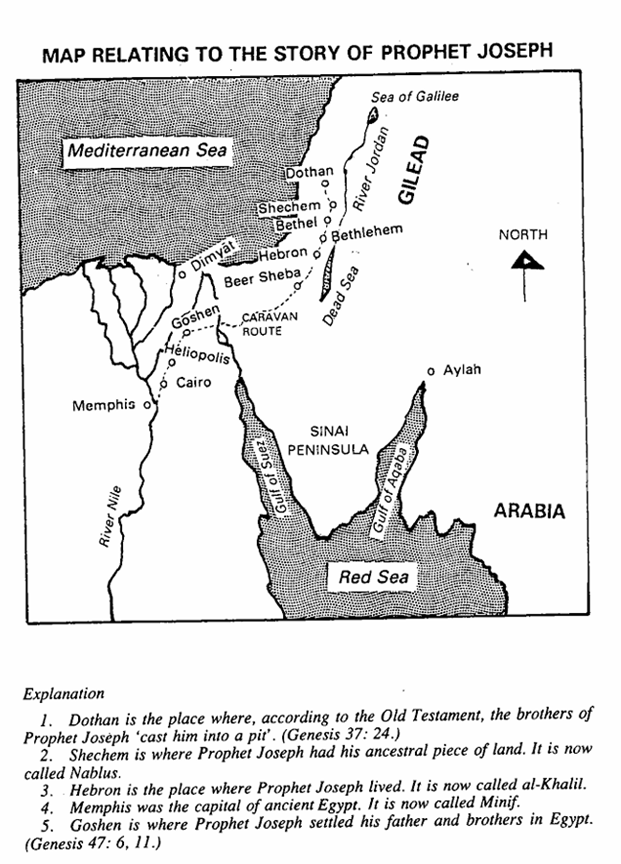
Jacob (peace be on him) was settled in the valley of Hebron, presently called al-Khalil, in Palestine. Both Isaac and Abraham (peace be on them) had lived there before him. Moreover, Jacob (peace be on him) had some of his property in Shechem, presently known as Nablus.
If we were to accept the findings of Biblical scholars, Joseph (peace be on him) was born in 1906 B.C. The incident mentioned in the present surah - his dream followed by his being cast into a pit - took place around the year 1890 B.C. At that time Joseph was seventeen years old. As to the pit into which he was thrown, it was situated, according to Biblical and Talmudic traditions, near Dothan to the north of Shechem. The caravan that rescued him from the pit was travelling from Gilead (Transjordan) en route to Egypt. The ruins of Gilead can still be seen to the east of the river Jordan in the valley of Elbas.
The 15th dynasty of Hyksos kings ruled Egypt at that time. They were of Arabian descent. Having moved from Palestine and Syria in 3000 B.C. to Egypt, they had seized power in Egypt. Both Arab historians and the commentators of the Qur'an refer to them as 'Amālīq (Amalekites). This accords with the recent findings of Egyptologists. In Egypt, their position was that of alien invaders who established themselves owing to internal dissensions obtaining in that country. This accounts for why Joseph (peace be on him) rose to political power in their regime. It also accounts for why the Israelites were subsequently and warmly welcomed in Egypt, were settled in the most fertile parts, and became highly influential there. All this is explained in terms of the racial affinity pertaining between them and the alien rulers of Egypt.
The Hyksos continued to rule over Egypt till the end of the fifteenth century B.C. However, during this period, political power actually rested with the Israelites. The Qur'an refers to God's favour upon them: 'when He raised Prophets amongst you and appointed you the rulers' (al-Ma'idah 5: 20). Later on, a massive national uprising took place and led to the overthrow of the Hyksos regime and the banishment of 250,000 Amalekites from Egypt. The Hyksos were replaced by a highly bigoted Coptic dynasty which virtually obliterated every remnant of the Amalekite period. The rulers of this dynasty also embarked upon a brutal oppression of the Israelites the details of which have been mentioned in the Qur'an in connection with the story of Prophet Moses (peace be on him). (See, for instance, al-Baqarah 2: 49 - Ed.)
A study of this period of Egyptian history reveals that the Hyksos did not at any point recognize the Egyptian pantheon of gods and goddesses. They had, instead, brought their own from Syria. They even tried to introduce and popularize their faith in Egypt. This explains why the Qur'an does not refer to the Egyptian sovereign contemporaneous with Joseph as Pharaoh, basically, because the word 'Pharaoh' had a religious connotation while the Amalekites did not subscribe to Egyptian religious beliefs and practices. The Bible, however, mistakenly refers to them as Pharaohs. Probably the compilers of the Bible believed indiscriminately that all Egyptian rulers were Pharaohs.
Modern scholars who have studied the Bible and Egyptian history from a comparative perspective believe that the king of the Hyksos dynasty, Apophis, was a contemporary of Joseph (peace be on him). Memphis was then the capital of Egypt. Today its ruins are to be found some fourteen miles to the south of Cairo. Joseph arrived there when he was about seventeen or eighteen years of age. He remained in the house of the Egyptian chief official for two to three years and then spent some eight to nine years in prison. At the age of thirty he took control of the government in Egypt and continued to rule effectively for eighty years.
In the ninth or tenth year of his rule, Joseph sent word to his father Jacob to migrate, along with his entire family, from Palestine to Egypt. In Egypt, Joseph settled there in the area lying between Dimyat (Damietta) and Cairo. The Bible calls this area Goshen. In the time of Prophet Moses (peace be on him), descendants of Joseph still lived in this area. According to the Bible, Joseph (peace be on him) passed away at the age of one hundred and ten. At the time of his death he enjoined that if the Israelites were to migrate from that land, they should carry his bones from there. (See Genesis 50: 24-6 - Ed.)
Biblical and Talmudic accounts of Joseph's story differ in many respects from the Qur'anic one. However, insofar as the basic components of the story are concerned, they are common to all three accounts. In the pages that follow, we shall draw attention, from time to time, to the aspects of disagreement found in these three sources.